The Resurrection
What happens when a forgotten diary finds its way into the hands of a stranger? Middleton's vendor Dyann Rupp shares the remarkable true story of a five-year diary from the 1920s, an unexpected mystery, and a journey that brought the past back to life. It's a touching reminder that the objects we leave behind sometimes carry stories far more valuable than the objects themselves.
Some of the most remarkable things we discover in antique shops aren't valuable because of their age, rarity, or monetary worth. They're valuable because of the stories they carry.
At Middleton's, we believe that preserving the past means more than caring for beautiful objects. It also means appreciating the lives, memories, and experiences connected to them.
We're delighted to share this remarkable true story written by one of our vendors, Dyann Rupp. What began with the purchase of a small antique diary became an unforgettable journey of discovery, friendship, and reconnecting a family with its history.
The Resurrection
By Dyann Rupp | Middleton's Vendor & Guest Contributor
Antiques speak to something deeply personal within us. They complete cherished collections, connect us to pivotal moments in history, and awaken memories long tucked away in our hearts. Often, they are more than objects. They are tangible links to the lives of those who once held them, loved them, and passed them through time. As their new caretakers, we become guardians of their stories, entrusted with preserving their legacy.
This is the true story of a diary started more than a century ago, and how the words of one life, captured on its pages, reached across generations to touch and profoundly impact lives today.

Sometimes the smallest discoveries hold the most remarkable stories. (Illustrative image)
In 1996, I was a busy graduate student with little time for hobbies. Still, I had begun collecting antique autograph books, and the search trained my eye to notice every small volume tucked among larger books at antique shows and garage sales. One day, with a few spare minutes, I stopped at an antique store. As I approached a bookcase, a small leather book wedged between larger volumes caught my attention.
I pulled it from the shelf and read the words “Five-Year Diary.” Disappointed that it was not an autograph book, I opened it casually anyway. Just inside the front cover was the name “Sarah King.”* The first entry was dated January 1, 1926—seventy years earlier. Something about it intrigued me enough to pay $15, a considerable sum for me at the time, and take it home.
Today, connecting the past with the present has become one of the great joys of my life. I have returned diaries, love letters, school-days books, autograph books, and photographs to the descendants of the people who once held them dear. Finding an interested descendant is not always easy, though social media and sophisticated genealogy sites have made the search far less difficult. More often than not, I succeed—but that was not always true.
In the late 1990s, however, I was more concerned with collecting than returning. Autograph books were quick reads, filled with beautiful handwriting and sentiments that felt tender and sincere. I could picture each writer with pen in hand, offering advice, copying a favorite poem, or drawing an elaborate calligraphy bird. Often there was a “remember” phrase—remember the sleigh ride; remember the school picnic. The people and the memories were long gone, leaving only the words and someone like me to wonder what laughter, embarrassment, or secret tenderness had lived behind them.
Now I had the diary of Sarah King, a young sorority woman at the University of Nebraska in Lincoln. She was a flapper who seemed determined to enjoy life fully. Her diary brimmed with dates, movies, and the ordinary adventures of college life. She even recorded the time she skipped out on a café tab—and the many, many times she missed curfew.
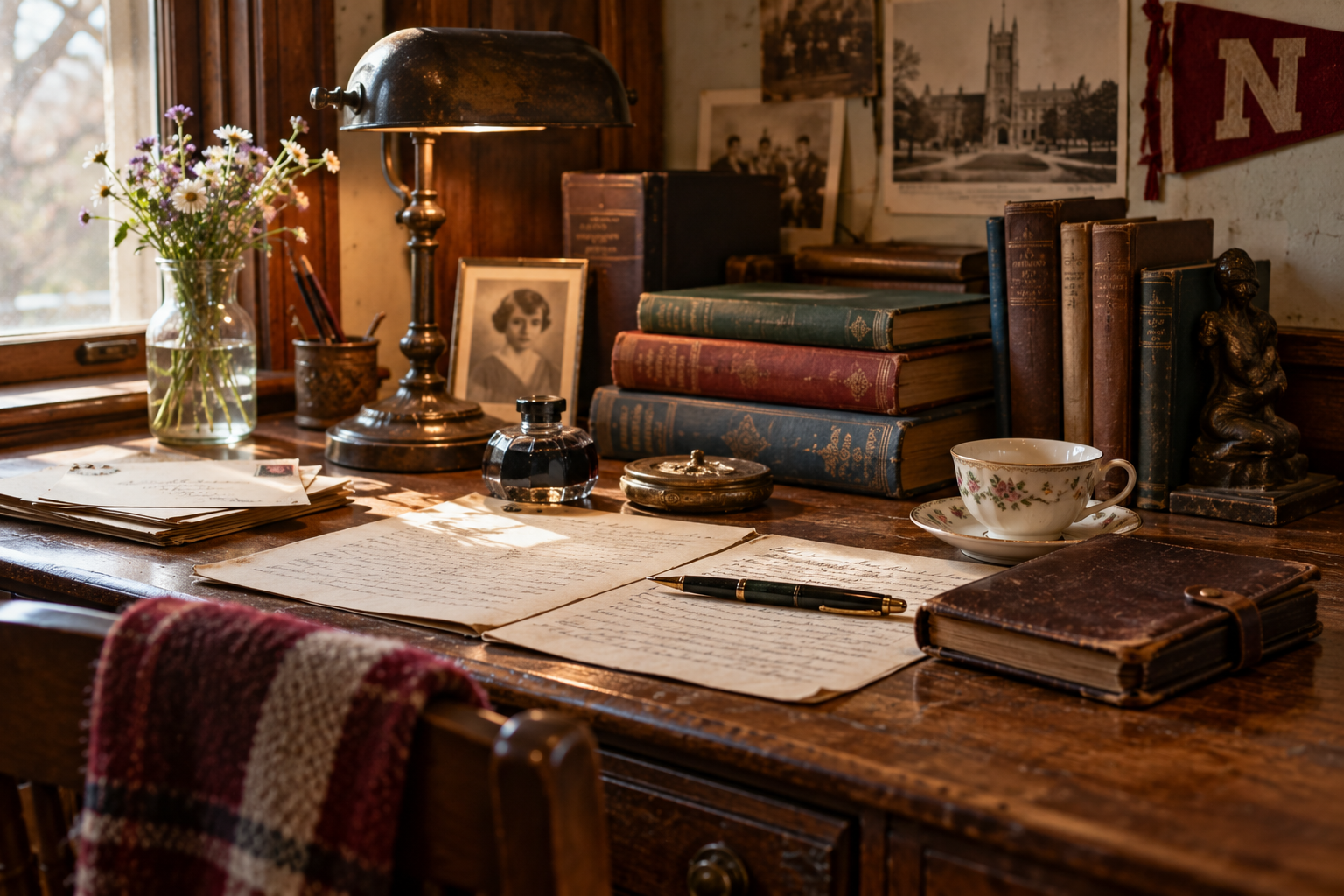
A diary offers an intimate glimpse into everyday life, including moments its writer may have long forgotten. (Illustrative image)
During the fourth year of the diary, while attending a summer term, Sarah met a fraternity president and was immediately smitten. His name was Charles Conroy, though in her entries he was always simply “Conroy.” They went on a date, and Sarah believed they had shared a wonderful evening. Then he never called.
Over the weeks and months, Sarah continued to fill the diary with movies, social gatherings, and other beaus—but something in her had changed. Every man was measured against Conroy, and every one fell short. Conroy had become “The One,” not merely a man she had dated, but the possibility she could not forget. In her world, seeking him out or approaching him herself would have been unthinkable. So she could only wait, wonder, and nurse a heartbreak she had no way to resolve.
Why had he never called? Had she said or done something wrong? Or had the evening meant far less to him than it had to her?
Her writing felt so honest. In every hopeful line and wounded question, I could feel the ache of a young woman trying to understand why the man she could not forget had forgotten her. Her heartbreak became real to me, and, perhaps unfairly, so did my resentment toward Conroy.
But sometimes life rewards us all with a second chance.
That fall, Sarah unexpectedly crossed paths with Conroy on campus. Whatever had kept them apart seemed to fall away. The connection she had remembered—and feared she had imagined—was real, and it was mutual. By the end of the semester, they had eloped. For two precious, nerve-racking weeks, they carried the secret between them before finally summoning the courage to tell their parents that they had chosen each other.
The newlyweds soon moved to Conroy’s rural hometown, where he farmed with his family. Sarah settled into life as a young wife. At first, she still recorded the small happenings of her days, but the entries grew farther apart. Again and again, she wrote of being tired. Then, without explanation, the words stopped.
The five-year diary still held nearly a year of empty pages. Sarah’s voice, once so lively and immediate, had simply vanished. The silence felt abrupt—unfinished.
In my mind, I questioned her: What happened to you, Sarah? Was Conroy truly “The One”? Were you ill? Were you expecting a child? Why did you stop writing?
How could I discover what had become of Sarah King Conroy? I did the math and assumed that the vibrant young woman on those pages was probably gone; she would have been in her eighties. It seemed logical she had died. Otherwise, surely she would still have her diary.
My curiosity could not be contained. Why did I care so much? Because her words had made her real. She had entrusted the pages with her hopes, her mistakes, and her heart. I wanted to know how her story ended. More than that, I wanted to know whether the life she had longed for with Conroy had made her happy.
I held the little diary in my hands—its leather cover worn smooth, its pages softened and yellowed by time. It contained so much life, so much history, and yet not nearly enough.
What happened to you, Sarah?
The diary was my only clue, and I felt compelled to know more. I tried searching the internet, though “surfing” may be too generous a word for what I was doing in those early days. I could wade. I could splash around a little. But surf? Hardly. Still, I did my best.
I searched for “Sarah King,” “Sarah Conroy,” and “Sarah King Conroy.” Nothing. No matter how I tried, I found no trace of her. Graduate school demanded more of my time, and eventually the diary returned to a bookshelf. But whenever I noticed it, I wondered again. I remember telling my husband, “Wouldn’t it be wonderful if I could find Sarah and experience her diary with her?” Even as I said it, I knew the chances were nearly zero.
Around that time, while visiting my husband’s grandparents, I mentioned my collection of autograph books. Grandma told me that her old autograph book was somewhere in the attic and that I could have it. She gave me a general idea of where to look, and off I went.
I love attics. I love opening boxes of forgotten treasures and seeing what people once believed they might need again—or, as I prefer to imagine, what they could not bear to throw away. I searched box after box and never found the autograph book. But I found something far more interesting: Grandma’s diaries.
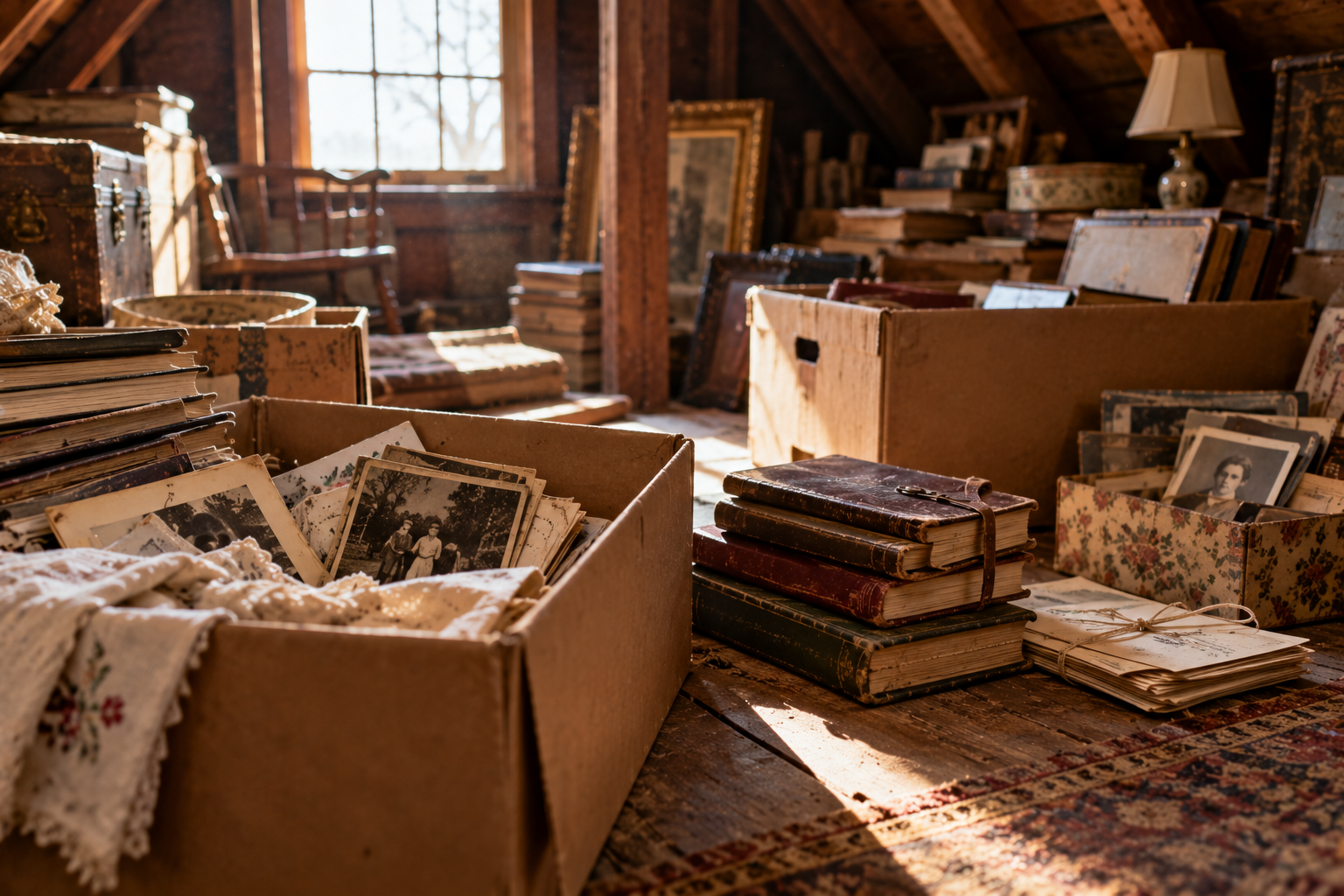
Attics and forgotten boxes often hold pieces of family history waiting to be rediscovered. (Illustrative image)
I carried the news back downstairs to the living room. Grandma laughed and said she did not remember ever keeping a diary.
During the hour-long drive home, I replayed the evening in my mind. Grandma’s words had awakened the old question. What if Sarah were still alive and, just like Grandma, no longer remembered keeping a diary? It was a long shot, I knew. Still, Sarah was back in my thoughts, and this time I could not put her away.
The next day, I took the diary from the bookcase, opened its front cover, and began searching again.
Once more, I searched Sarah’s names and the town where she had moved. Then it occurred to me that I had been following the wrong person. Perhaps I should search for Conroy. That thought was the breakthrough. I discovered that Charles Conroy had died in Lincoln, Nebraska, not far from the rural community where he had grown up and farmed with his family. I found his obituary online and read it eagerly. At last, I thought, I would learn what had happened to Sarah.
But there was no Sarah. There was “Lucy.” The obituary named Lucy as Charles Conroy’s wife.
I leaned back in my chair, bewildered. Who was Lucy? A second wife? A nickname?
I went back to the obituary and cross-referenced the diary. The year of their wedding ceremony in the obituary corresponded with the year of the elopement in the diary. “Lucy” had to be a nickname. There was only one way to find out: Talk to Lucy directly.
I grabbed the telephone book and turned to the C’s. There it was: Lucy Conroy—a name, a telephone number, and an address. I decided that I would drive there, introduce myself, and finally solve the mystery.
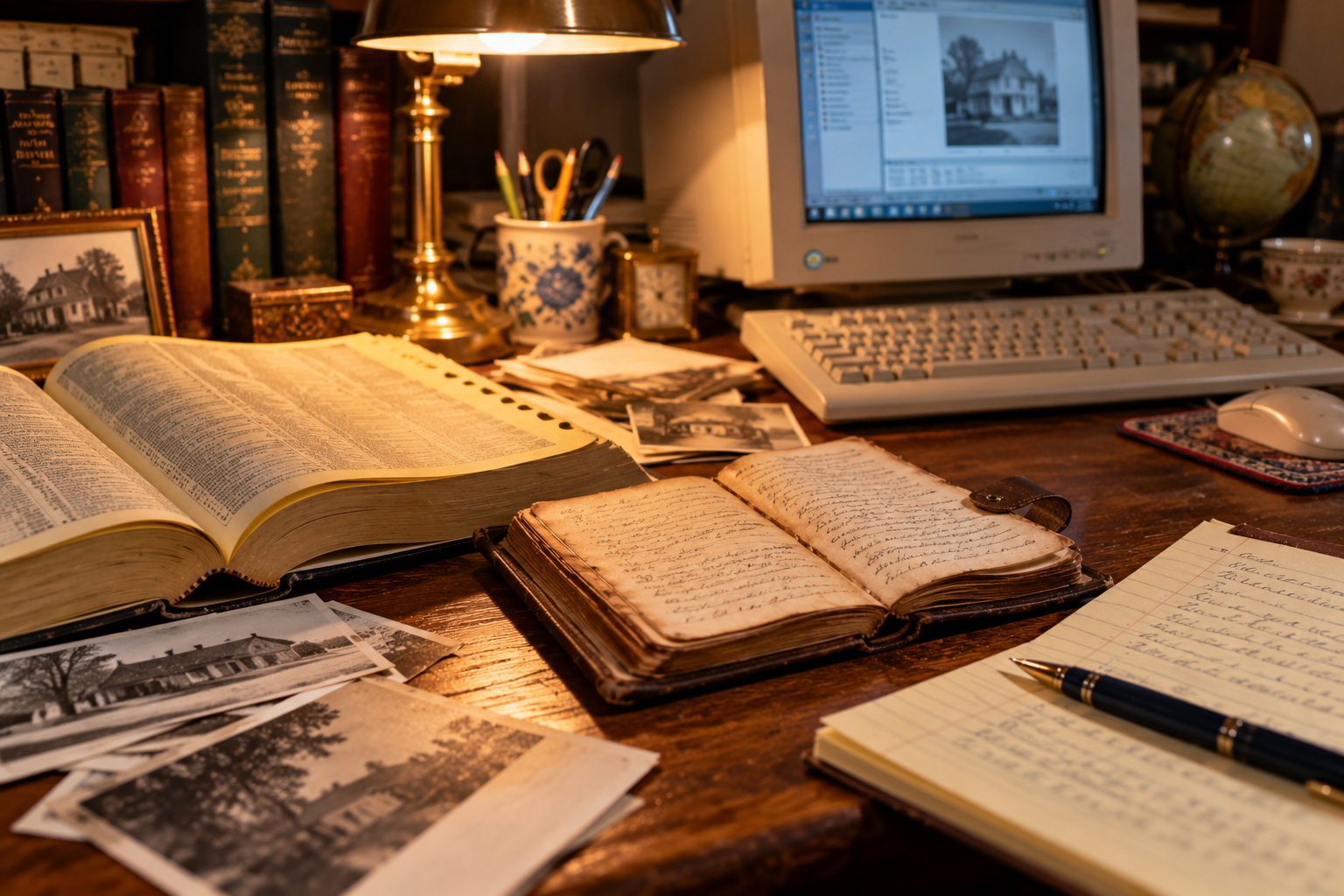
Before today's genealogy tools, tracing someone's history often meant searching old directories, records, and newspaper notices. (Illustrative image)
The next morning, I pointed my little Honda toward Lucy’s address. I was determined, excited, eager, anxious, and unsure—all those feelings knotted together. When I arrived, I parked, entered the facility, and studied the list of residents and apartment numbers.
No Lucy Conroy.
I looked again.
She was not listed.
Now what?
Just then, a man leaned out of the office. “Who are you looking for?” he asked.
“Lucy Conroy.”
“Lucy? She died two weeks ago.” Then he disappeared back into his office.
I stood there stunned. She had died? Two weeks ago? I had owned the diary for months. How could I have come so close, only to arrive fourteen days too late? The loss felt strangely personal. I had never met Lucy, yet I grieved the conversation we would never have and the memories I would never hear.
The title of this story is “The Resurrection.” Whenever I remember what happened next, I think of Easter: life, death, and resurrection.
If you do not believe in angels, then what followed was a coincidence that still defies explanation. I had just left the lobby and when another man approached the building. He noticed me and asked, “Who are you looking for?”
Inside, I thought, No one now. She died. I’m fourteen days too late.
Aloud, I said, “Lucy Conroy. But she died.”
“No, she didn’t,” he replied. “She moved to Mercy Manor.”
For a moment, I could hardly understand him. Then the words landed: She was alive. Lucy was alive.
I hurried back to my car, drove to Mercy Manor, found Lucy’s apartment number, and knocked on her door.
From inside came “Who is it?” I opened the door and said, “You don’t know me.” After introducing myself, I asked, “Are you Lucy?”
“Yes.”
“I think I may have your diary.”
“I didn’t keep a diary.”
“Did you elope with Charles Conroy in December 1930?”
“In Wahoo, Nebraska,” she answered.
“Lucy,” I said, “I have your diary.”
Her smile appeared at once. When I placed the little book in her hands, she pressed it against her chest. “I don’t remember keeping a diary,” she said. “How did you get it?”
I told her the story. Then she explained that macular degeneration had taken away her ability to read it. Barely a second passed before I said, “I’ll read it to you. I’ll come back, and we’ll read every page—for however long it takes.”
And that is exactly what we did. One afternoon each week, I arrived at Lucy’s apartment, opened the diary, and read while she remembered. She was astonished that she had skipped out on a café tab—and even more astonished that she had written it down. She could hardly believe how often she had broken curfew. “It’s a good thing your children never found this,” I teased. “You would have been busted!”

Reading the diary together gave Lucy an opportunity to revisit memories from her younger years. (Illustrative image)
Eventually, I asked her about “Sarah King.”
“Who?” she asked. I explained that Sarah’s name and address appeared inside the front cover. For all those years, I had believed I was searching for Sarah King. Instead, I had found Lucy Conroy.
“I don’t remember who she was,” Lucy said. “I don’t know why her name is in the front cover.” I never pursued the mystery of Sarah King. By then, she was no longer the person whose story mattered most.
I finally asked the question that had lingered with me from the beginning: Why hadn’t Conroy called after their first date? Lucy told me she had eventually asked him the same thing. His family, he explained, had not wanted him tied down so young. All those months, she had wondered whether the evening had meant anything to him. At last, I knew the truth: Conroy had been every bit as smitten with Lucy as she had been with him.
Even after we finished the diary, I continued to visit Lucy. One day, I was barely through the door when she announced excitedly, “I know how I lost it!”
Sometime after Conroy died, Lucy moved into assisted living. Because she no longer remembered the diary, the boxes of books in her attic were thrown into a trash bin. A family friend rescued them and later sold them at a garage sale. When the friend discovered a diary among the books, she opened it and saw the name “Sarah King” inside the front cover. Like me, she assumed it belonged to Sarah and sold it, never realizing that the diary—and the life inside it—belonged to Lucy.
Lucy loved reminding me her friend had sold the diary for a quarter—and I paid $15 to bring it home. After we read the diary together, Lucy passed the heirloom on to her granddaughter. After all the miles and misunderstandings that had carried it away from her, the diary had finally found its rightful place: back in the hands of her family.
Lucy died a couple of years later. I had been away for an extended period, and when I returned, her telephone number had been disconnected. I searched three weeks of obituaries and found the notice of her death. This time there was no mistake.
Lucy’s story remains one of the most meaningful gifts of my life. I am grateful for the internet, for unlikely coincidences, and for the people who appeared at precisely the right moments. Most of all, I am grateful that I met Lucy—that she trusted me to read her younger self back to her, and that, for a little while, we were able to step into her past together. Returning that diary did more than restore a lost possession. It showed me that the things people leave behind can carry love, memory, and identity across generations.
If not for Lucy, I might not have continued searching for the families connected to the treasures I find. Every descendant who receives a family heirloom from me is part of the quiet legacy she left behind. In that way, a little diary rescued from obscurity continues to bring pieces of the past home—and Lucy, through every reunion, lives on.
*This story is true. However, names and identifying details have been changed.
About the Author
Dyann Rupp is a vendor at Middleton's Antiques, Books & Uniques in Lincoln, Nebraska. Her story, “The Resurrection,” reflects the extraordinary connections that can be made through antiques, family keepsakes, and the preservation of personal history.
At Middleton's, we're grateful to Dyann for sharing this story with our readers. It's a beautiful reminder that the things we preserve are often far more than objects—they're connections to people, memories, and lives that might otherwise be forgotten.
Explore more stories and discoveries in The Middleton's Journal, or visit us at 1615 S. 17th Street in Lincoln, Nebraska.